Rhizoma Corydalis
Rhizoma Corydalis is the dried tuber of Corydalis yanhusuo, a poppy-family plant with centuries in Chinese herbal tradition — and in 2026, the ingredient behind tablets like ketaMIND. Here's the plant itself: botany, alkaloids, safety record and legal status, no health claims.
Ships fast · $50 minimum · free over $125
Corydalis on the menu
Ships nationwide in plain, unmarked packaging. We don’t publish a third-party panel for these, so we make no claims beyond the label.
| Botanical name | Corydalis yanhusuo — yán hú suǒ in Chinese herbal tradition. “Rhizoma Corydalis” (or Corydalis Rhizoma) is its pharmacopoeia name |
|---|---|
| What it is | A small spring-flowering perennial in the poppy family (Papaveraceae), native to China and grown for its small, round underground tuber |
| The part on the label | The dried tuber. “Rhizoma” is the traditional pharmacopoeia term, though botanically it’s a tuber rather than a true rhizome |
| Named alkaloids | Isoquinoline alkaloids — tetrahydropalmatine (THP), corydaline, dehydrocorybulbine (DHCB) and protopine among those isolated in published studies |
| Published receptor data | Its best-known alkaloids act mainly at dopamine receptors in lab studies — a different chemical class, and a different receptor story, from kratom’s mitragynine |
| Legal status | Not a federally controlled substance, and not part of the 2026 7-OH scheduling. We know of no state that bans it as of October 2026 |
Botany, published data and legal status only — no health claims, no dosing guidance, ever.
A poppy-family tuber with a long pharmacopoeia history
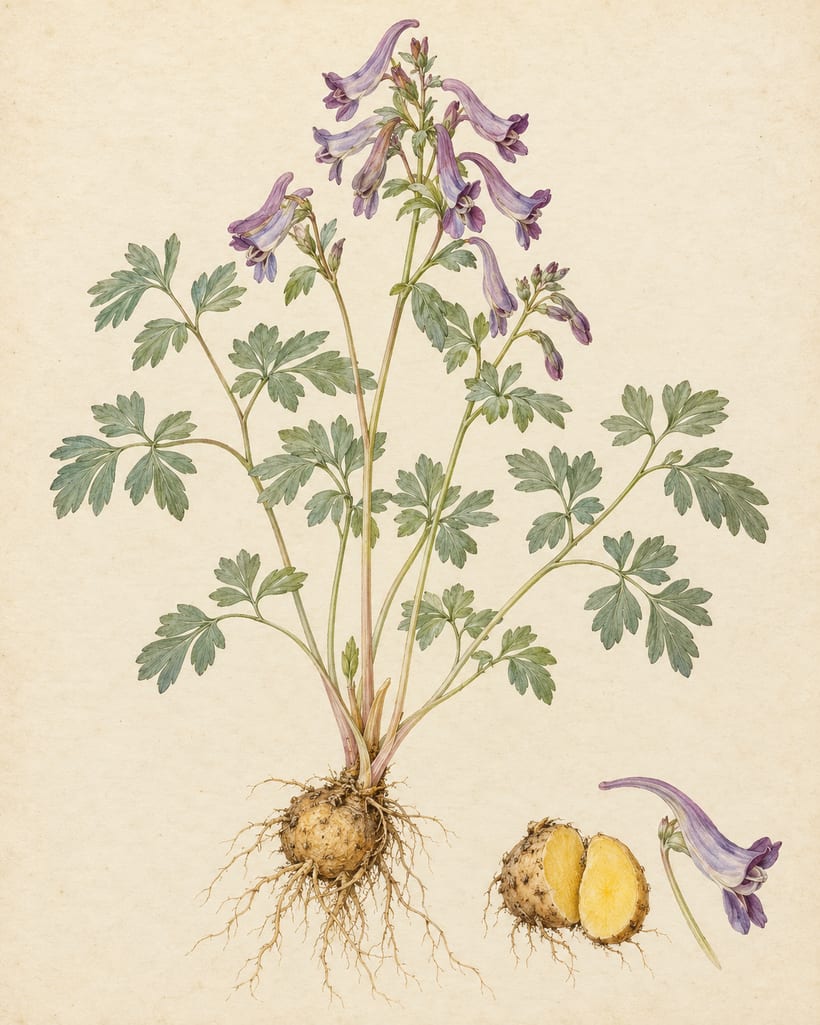
Corydalis yanhusuo is a low spring plant with tubular purple flowers, native to China and cultivated there for the small, round tuber it grows underground. Dried, that tuber is what Chinese herbal tradition calls yán hú suǒ and what pharmacopoeias list as Rhizoma Corydalis — the name you’ll find printed on a 2026 tablet box. It’s a member of the poppy family, which puts it a long way, botanically, from kratom and cat’s claw, both coffee-family plants.
The chemistry is a family of isoquinoline alkaloids. Tetrahydropalmatine (THP) is the best known, alongside corydaline, protopine and dehydrocorybulbine (DHCB). In published lab studies, these act mainly at dopamine receptors — not the opioid receptors at the center of kratom’s regulation. DHCB reached US headlines in 2014, when researchers at UC Irvine and China’s Dalian Institute of Chemical Physics isolated it and reported its receptor activity in mice in the journal Current Biology. That was animal research: there are no human trials behind it, and it isn’t a claim about any product, ours included.
The safety record, plainly
Two findings belong on any honest corydalis page. In 1993 the CDC reported cases of hepatitis linked to Jin Bu Huan, a Chinese herbal product labeled as containing tetrahydropalmatine; NIH’s LiverTox database counts more than a dozen such cases, while noting a contaminant may have been to blame. And in August 2022 the Massachusetts Cannabis Control Commission issued a precautionary bulletin about cannabis edibles containing corydalis and liver injury, opening an investigation without ordering a recall. Neither finding is about the tablets on shelves today, and neither is a reason to panic. Both are reasons to talk to a doctor first if you have liver concerns or take prescription medication.
What the name means on a shelf in 2026
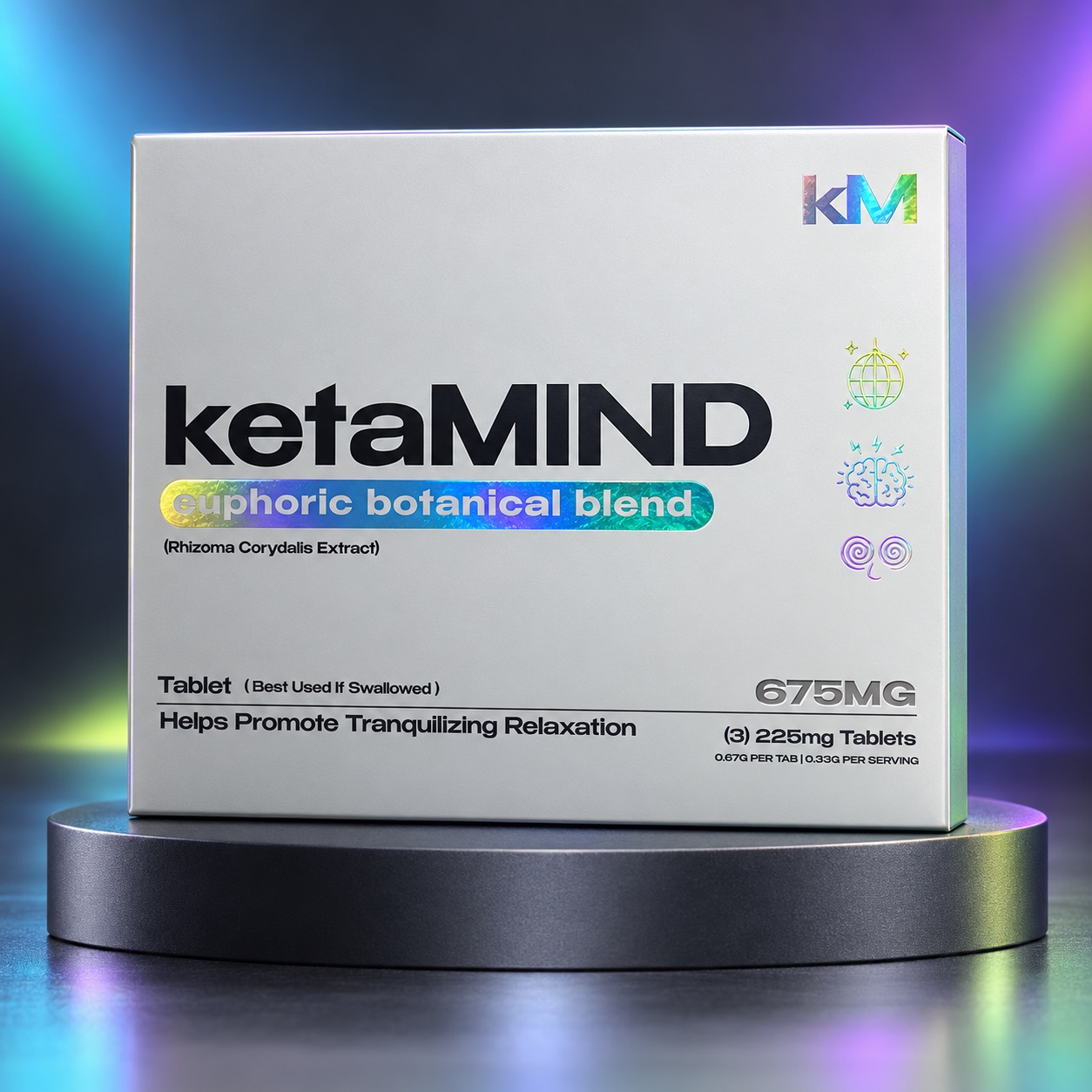
After the August 2026 federal scheduling of concentrated 7-OH (what changed), corydalis tablets arrived at smoke-shop retail with names built to turn heads: ketaMIND, and products labeled with a compound called “13-OH”. Neither name is what it sounds like. ketaMIND contains no ketamine; its label lists Rhizoma Corydalis extract. And “13-OH” isn’t a standardized name anywhere in the published research on this root, and has nothing to do with kratom’s 7-OH. It’s the same pattern as the cat’s claw wave: a legal, old botanical, and a new label that asks you to assume more than it says.
What we carry in this lane right now is ketaMIND (13-OH) Tablets 3pk 675mg. Same rules as this page: label facts, no effect claims, and no published third-party panel behind it — we won’t pretend otherwise.
Rhizoma Corydalis, answered
What is Rhizoma Corydalis?
Is ketaMIND ketamine?
What is 13-OH?
Is corydalis the same as kratom?
Is corydalis legal?
Are there safety warnings about corydalis?
Do you sell corydalis?
The plant, the law, the plain answer.
Questions about anything in this lane? Text us — a real person answers.
How shipping works — $125+ ships free.