Uncaria Tomentosa
Cat's claw is an Amazon vine with claw-shaped thorns, a coffee-family pedigree, and decades on American supplement shelves — and in 2026 its name started appearing on products that are a very different story. Here's the plant itself: botany, alkaloids, and legal status, no health claims.
Ships fast · $50 minimum · free over $125
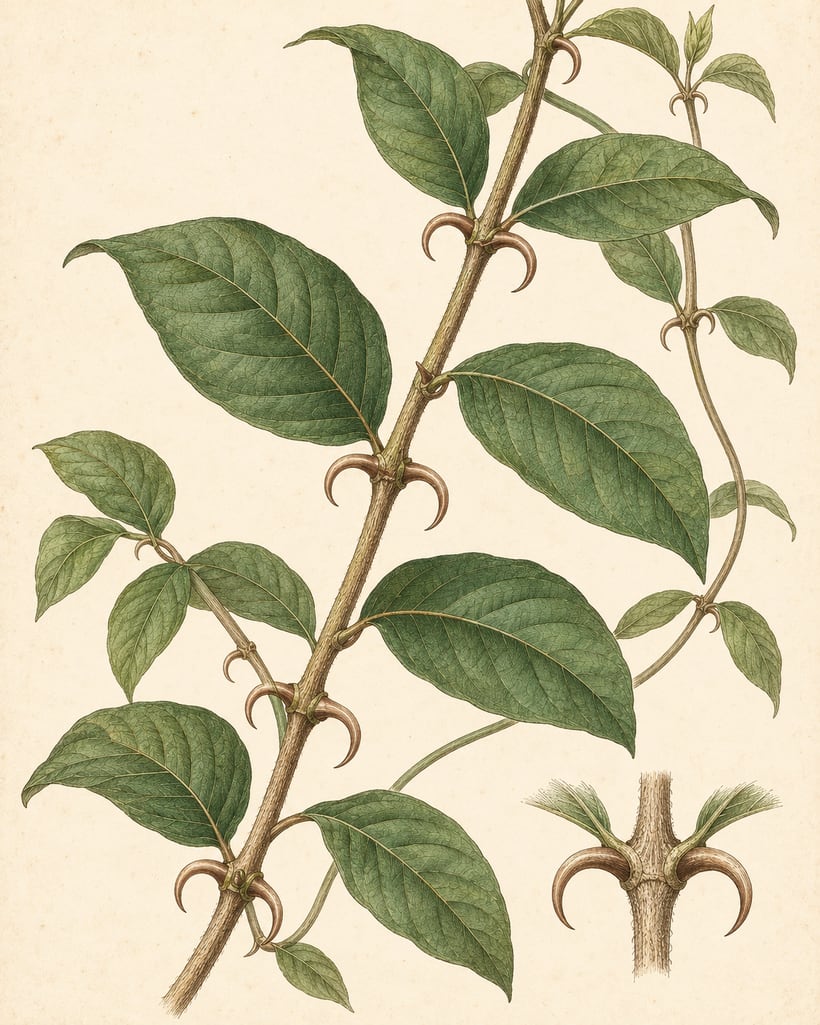
| Botanical name | Uncaria tomentosa — “uncaria” from the Latin uncus, a hook, for the claw-shaped thorns where its leaves meet the stem |
|---|---|
| What it is | A woody climbing vine of the Amazon basin — Peru and neighboring countries — in the coffee family (Rubiaceae), the same plant family as kratom |
| History | Its inner bark and root have been used in traditional South American herbal practice for generations; it entered the US supplement aisle decades ago |
| Named alkaloids | Oxindoles — mitraphylline and rhynchophylline chief among them, with related minors |
| Published receptor data | The named alkaloids show no measurable binding at opioid receptors — which separates the herb sharply from kratom’s chemistry |
| Legal status | Sold as an ordinary dietary supplement in all 50 states — not part of the kratom-specific federal action or state bans |
Botany, published data and legal status only — no health claims, no dosing guidance, ever.
A vine, a hook, and a very old shelf life
Uncaria tomentosa climbs trees in the rainforests of Peru and its neighbors, anchoring itself with curved thorns that look enough like a cat’s claws to have named the plant in at least three languages — uña de gato in Spanish, before English borrowed the image. Its inner bark and root carry generations of use in traditional South American herbal practice, and it crossed into the US supplement aisle decades ago, where it has been sold ever since as an ordinary botanical — legal in all 50 states, no scheduling, no state bans.
Botanically it’s a distant cousin of kratom — both belong to the coffee family — but the chemistry splits where it matters. The alkaloids cat’s claw is known for are oxindoles, mitraphylline and rhynchophylline chief among them, and published receptor data shows no measurable opioid-receptor binding for those compounds. Kratom’s mitragynine is the opposite case — opioid-receptor active, and regulated accordingly. Same family, different chemistry, different rules; the side-by-side comparison lays it all out.
What the name means on a shelf in 2026
After the August 2026 federal scheduling of concentrated 7-OH, a wave of tablet products wearing the cat’s-claw name appeared at smoke-shop retail — and regulators noticed before anyone else did: Utah Poison Control warned in July 2026 that some products in this category may be adulterated with scheduled kratom-derived compounds, and the Missouri Attorney General opened an investigation into manufacturers. We’ve written the honest read on that wave brand by brand — Dopium, Fuzziez, Buzzers & Homiez — and the chemistry behind it in the alkaloid explainer.
The lines we chose to carry in this lane are blend. IndoBlend — Uncaria tomentosa chewables at 100mg and 250mg per tab — and LOADED Botanical Blend. Their pages hold to the same rules as this one: label facts, no effect claims, and the documentation question always answered straight — text us and ask.
Uncaria tomentosa, answered
What is Uncaria tomentosa?
Is cat’s claw the same as kratom?
Are there different kinds of cat’s claw?
What alkaloids are in Uncaria tomentosa?
Is cat’s claw legal?
Do you sell cat’s claw?
The plant, the paperwork, the plain answer.
Questions about anything in this lane? Text us — a real person answers.
How shipping works — $125+ ships free.